From Popayán to Valparaíso: a team from Unicauca presented a pioneering advance...
From Popayán to Valparaíso: a team from Unicauca presented a pioneering advance in quantum games at an international conference in Chile
29 April, 2026
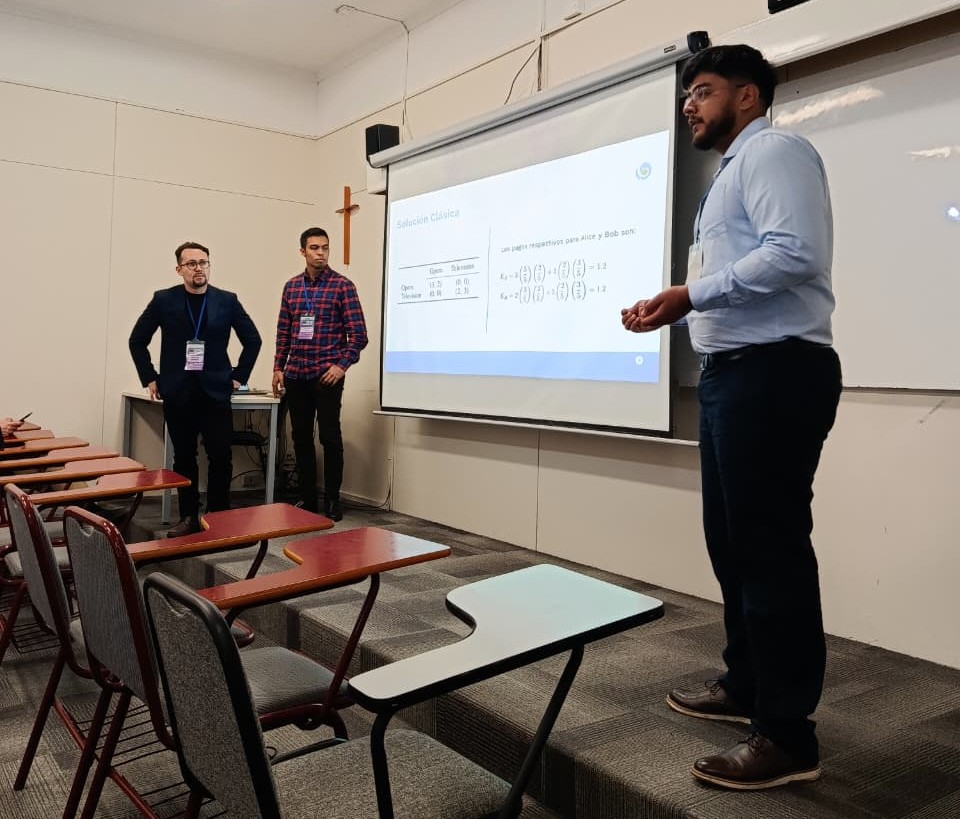
The Faculty of Natural, Exact and Education Sciences highlights the participation of a team made up of students, alumni, and a professor from the University of Cauca in the 2nd Latin American Workshop on Quantum Engineering and Software (TLISC 2025), hosted by the Pontificia Universidad Católica de Valparaíso, Chile. During the event, the group presented an unprecedented experimental advance in quantum game theory executed on real hardware. The proposal, based on an innovative strategy to mitigate errors in NISQ processors, stood out among Latin American academic contributions for its rigor, applicability, and potential scientific impact.
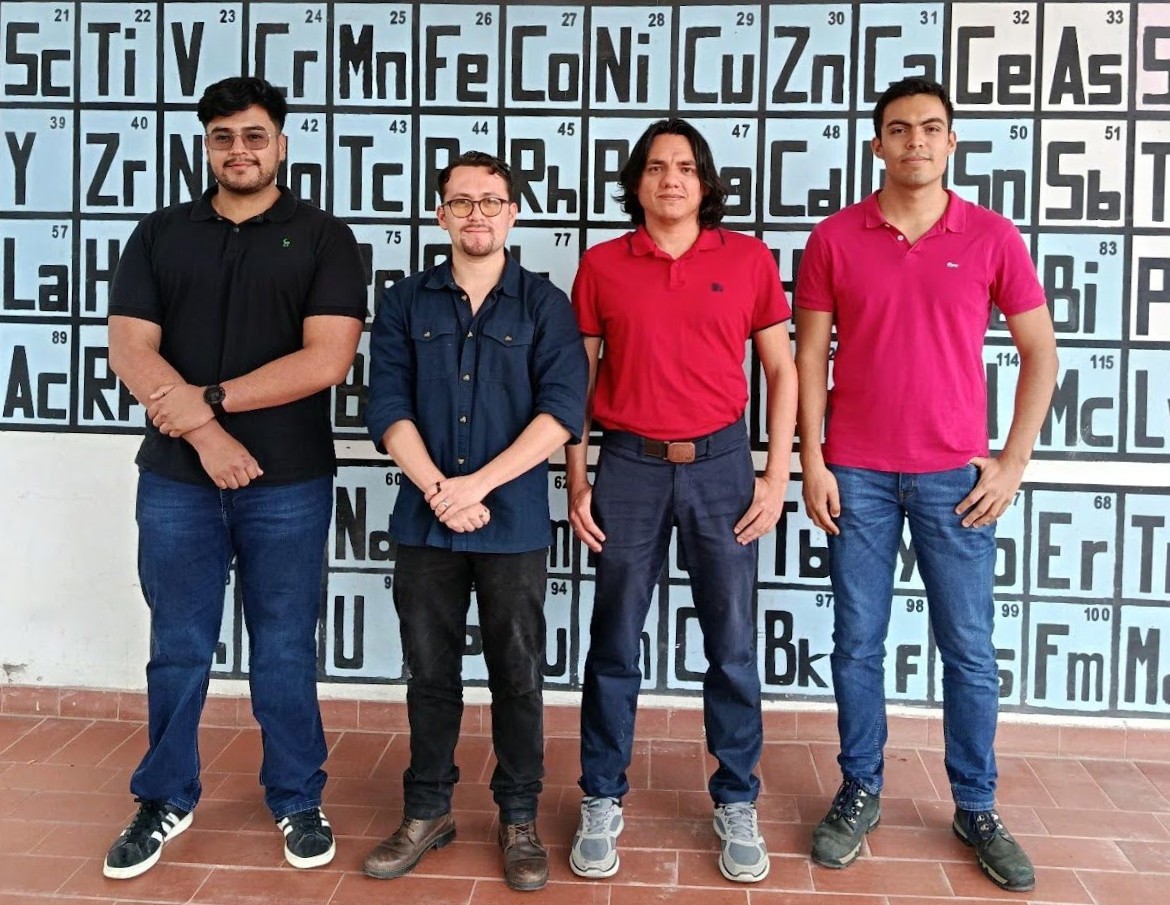
The work was developed by Physical Engineering students Germán Darío Díaz Agreda and Mateo Buenaventura Samboní, together with graduates Carlos Andrés Durán Paredes and Sebastián Cajas Ordoñez (CeADAR – University College Dublin), and Professor Jhon Alejandro Andrade from the Department of Physics (University of Cauca).
The article presented one of the first experimental milestones of the coordination game Battle of the Sexes executed on real quantum hardware, supported by the theoretical framework Eisert–Wilkens–Lewenstein (EWL). The authors proposed the strategy Guided Circuit Mapping (GCM), capable of dynamically selecting qubit pairs and optimizing their allocation to reduce the characteristic noise of NISQ (Noisy Intermediate-Scale Quantum) processors. The experiments conducted on the superconducting processor ibm_sherbrooke demonstrated that, even under realistic hardware conditions, it was possible to preserve quantum strategic advantages, with relative errors between 3.5% and 12%. This achievement brought quantum game theory closer to potential applications in economics, multi-agent artificial intelligence, and distributed systems.
As explained by Carlos Andrés Durán, one of the main motivations for the team to approach this topic from an experimental perspective on real quantum hardware was the lack of complete experimental implementations of the Eisert–Wilkens–Lewenstein (EWL) theoretical framework on real quantum processors. “Although quantum game theory has solid foundations, the group identified the need to contrast these predictions with results obtained directly on NISQ hardware, leveraging the group’s previous experience in quantum programming and experimental analysis.”
Provided Photo.
Provided Photo.
The presentation at TLISC 2025 represented a valuable opportunity to share these advances with the Latin American academic community, receive feedback from specialists, and open new possibilities for interdisciplinary collaboration. In this regard, Carlos Andrés Durán noted that “the researchers’ comments focused on the interest in the experimental implementation of the quantum game, the possibility of extending the methodology to other models, the analysis of the limitations inherent to NISQ hardware, as well as proposals to expand the statistical evaluation and explore other quantum computing architectures.”
Likewise, the publication of the article in a journal edited by the Institute of Electrical and Electronics Engineers (IEEE) contributed to expanding the visibility and academic validation of this work. Additionally, the preliminary version of the article is available for public consultation in the repositories arXiv and Hugging Face Papers, where readers can access the methodology and experimental results, as well as the authors’ contact information for collaboration requests, supplementary materials, or technical inquiries.
This achievement is also the result of the institutional support that the University of Cauca has provided to strengthen research in quantum computing, through the support of research groups for students and research groups, the creation of academic spaces, and the promotion of interdisciplinary initiatives. The guidance of Professor Jhon Alejandro Andrade from the Department of Physics, together with the collaborative work of the Orígenes research group and the contribution of the IDS Group, led by professors César Alberto Collazos Ordóñez and Julio Ariel Hurtado Alegría, has made it possible to consolidate capacities in quantum programming and software engineering applied to emerging technologies.
Likewise, the collaboration with the Ibero-American Network for the Advancement of Quantum Software Engineering (RIPAISC) and the institutional support for participation in TLISC 2025 facilitated access to real quantum computing platforms, such as IBM Quantum, and strengthened the academic and scientific projection of this work at both regional and international levels.