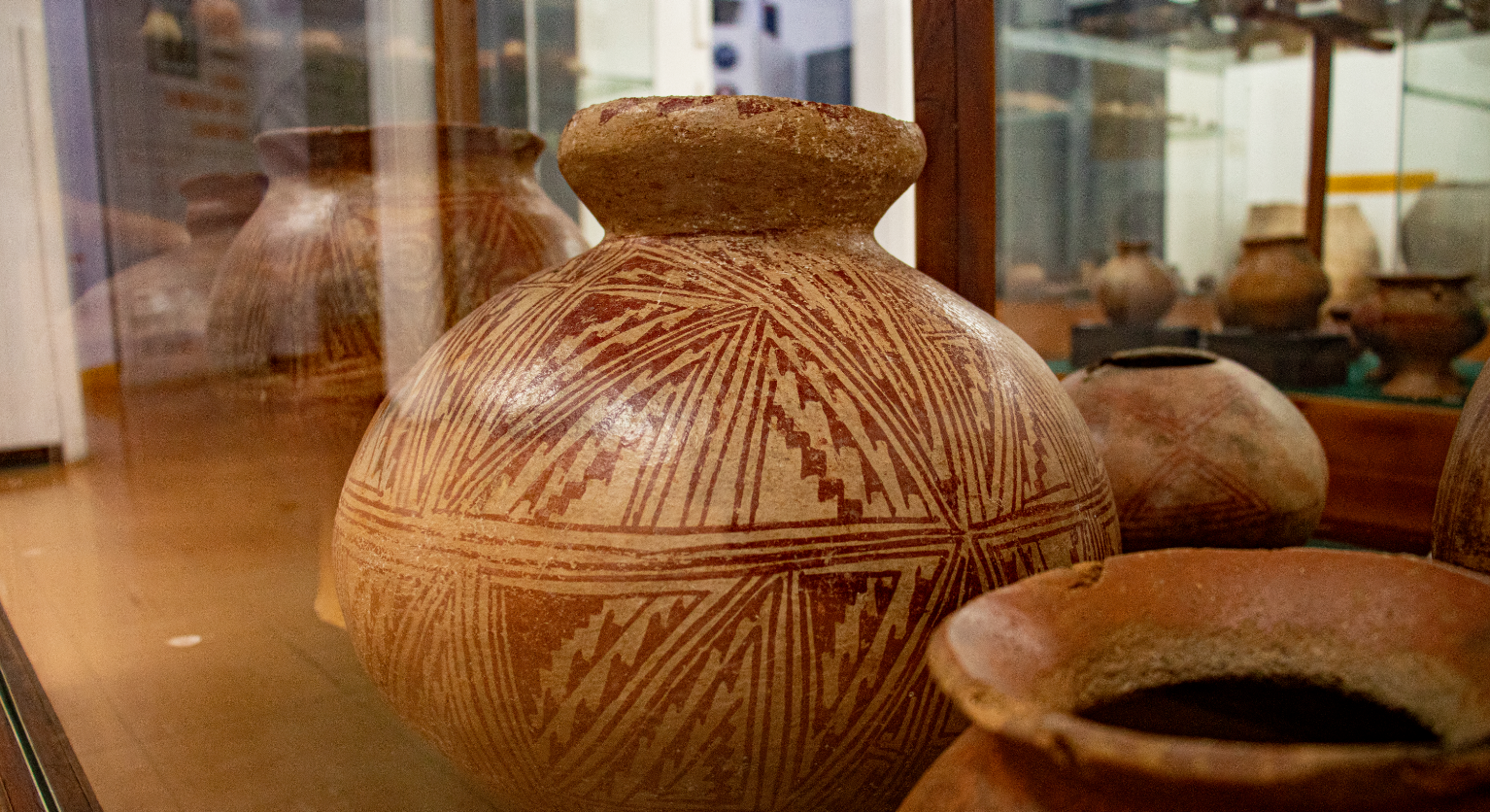
Currently, the Archaeology Laboratory is located on the third floor of the Natural History Museum of the University of Cauca. Its annex is a Ceramic Collection that houses a collection of archaeological pieces that constitutes a synthesis of the artifacts collected by the German researcher Henri Lehmann in 1936, when he established the Archaeological Museum with the support of the University of Cauca and the local ruling class. During the 1940s and 1950s, with the presence of the Ethnological Institute of Cauca, its researchers continued the work of acquiring and obtaining artifacts from the many excavations carried out throughout the southwestern region of the country. Since 1971, with the establishment of the Department of Anthropology and the conducting of numerous archaeological investigations, the Department continued collecting diverse archaeological materials, consolidating the reference collection with these new materials. In addition, pieces were placed on loan by the local Archbishop, along with various materials confiscated by ICANH that have been delivered to the University of Cauca to be preserved and cared for as part of Colombia’s heritage.
The Diversity of Archaeological Materials
This is due to the diversity of its provenance, as the original Lehmann collection was supplemented by contributions from research conducted by the Ethnological Institute, purchases from looters, materials excavated at Morro de Tulcán, and materials from the areas around Popayán, Tierradentro, and Moscopán. In the 1980s, Professor Miguel Méndez conducted the first Historical Archaeology studies following the 1983 Popayán earthquake. For more than a decade, he excavated all the churches in the Historic Center (San Agustín, San Francisco, and Santo Domingo), the El Carmen and La Encarnación convents, most of the historic buildings of the University of Cauca, as well as several historical sites in Timbío. Professor Méndez managed to assemble a comprehensive collection of Historical Archaeology materials from the city and surrounding areas, which was combined with the lithic and ceramic materials from the pre-Hispanic site of La Balsa, where he had previously conducted research.
Elements for Archaeological Study
The archaeological work of Professors Cristóbal Gnecco and Carlos Humberto Illera contributed new elements during the 1990s. Subsequently, the archaeological work of Professor Diógenes Patiño, initially in Tumaco, Patía, and Valle del Cauca, continued to consolidate the collection, which has been further enriched by new Historical Archaeology materials found at the Casa de la Moneda and, more recently, in Puracé.
More than seven (7) years ago, the process of registering the artifacts with ICANH began. This has been a lengthy and complex task that has involved two occasional faculty members with training in Archaeology and museology. Students in the various seminars within the Archaeology emphasis are trained in the registration and curation of artifacts, and their participation in this process is important. At the same time, the museum has an exhibition space on the third floor, where part of the archaeological collection is continuously displayed to the public. Six (6) years ago, Professor Guillermo Ospina was temporarily responsible for the care, protection, and exhibition of the archaeological collection. In this regard, two new public exhibitions were organized, and he also secured funding through a Colciencias research project aimed at digitizing the archaeological collection, a process that is still underway.
The Archaeology Laboratory has the basic resources required for training and practical work in archaeological fieldwork, as well as for the analysis of lithic and ceramic materials. It houses one of the most comprehensive collections of Historical Archaeology materials in our country, including colonial ceramics such as majolica and earthenware, samples of construction materials, metals, bricks, etc. There is also a basic reference collection comprising materials from all the locations in the southwestern region where the anthropologists of our Department have conducted research projects, salvage excavations, and student thesis projects.
Ceramic Collection
Indigenous Heritage in the Department of Cauca
Our Indigenous ceramic collection is very comprehensive and includes specimens from throughout the Department of Cauca, the southwestern region, and some foreign materials (Peru and Ecuador). It is kept under secure conditions and is accessible only to faculty members and authorized personnel. The alternate campus of the Faculty of Humanities and Social Sciences is currently under construction, for which new spaces have been allocated to house the Ceramic Collection, the Archaeology Laboratory, the Bioanthropology Laboratory, and a new exhibition hall for Archaeology or Visual Anthropology. A video library is also planned, which will be shared with the History Program. For the time being, the video library is under the custody of the Central Library while construction of the new facilities between 5th Street and 4th Avenue is completed.